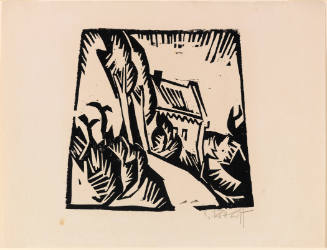
The Breezy Common
Sheet: 11 × 8 1/16 in. (27.9 × 20.5 cm)
Matted: 19 1/4 × 14 1/4 in. (48.9 × 36.2 cm)
Maurice Prendergast's The Breezy Common (CR 1661) is a variation on the composition of another monotype and its cognate, both of which also bear the title The Breezy Common (TF 1992.73, CR 1657, and TF 1992.74, CR 1658). Although sharing the other works' high horizon, this composition differs in its vertical orientation, which diminishes the breadth of green lawn in the background and emphasizes the flattened, tipped-up space. The dominant figures in the left foreground here consist of only one woman and a girl. Their dresses add strong notes of peach and white. In the background, a flurry of pastel-tinted shapes, suggesting a flock of birds in flight, represents running girls dressed in bright colors. A deep green line border framing the composition is inscribed with the title and the artist's signature.
Until 1896, the artist and his brother Charles Prendergast lived in Roxbury, a Boston neighborhood adjacent to Franklin Park, the largest green space in a continuous string of parks designed by landscape architect Frederick Law Olmsted in the late nineteenth century. In the 1890s, leisure time for the working-class was a revolutionary new concept. For urban industrial workers, Franklin Park was considered an ideal spot to spend one's weekends.
Prendergast made eight monotypes that are variations on the composition seen in this example, based on a watercolor sketch from the "Boston Water-color Sketchbook" (Museum of Fine Arts, Boston, CR 1478). The artist produced scenes of Franklin Park in other media, including the oil painting Franklin Park, Boston (TF 1999.112) and two watercolors of the same title (TF 1999.111 and TF 1999.113). The "Franklin Park" suite should be considered a subset of the series "Children at Play."
According to the inscription in graphite in the bottom margin of the paper, this monotype was a New Year's gift to fellow artist Walt Kuhn in 1921. Prendergast and Kuhn met while helping to organize the important so-called Armory Show of 1913, and their friendship flourished after Prendergast moved to New York City, where Kuhn lived, in 1914. For more information on this and more of Prendergast’s work, see Maurice Brazil Prendergast, Charles Prendergast: A Catalogue Raisonné (1990), to which the CR numbers for the monotypes noted above refer.